


So That They May Be Seen; A Walk Through Black Churches as Museums in the 19th Century Philadelphia
- Michiko Quinones
- May 15
- 21 min read

How Black Philadelphia built its own cultural infrastructure because the white one was bolted shut. A story that begins with a telescope.
This is a story about about how Black churches in 19th-century Philadelphia were doing the work of museums, libraries, science halls, and historical societies when the city's white-run institutions either refused to evaluate Black work or refused to admit Black people through the front door.
It is the story of two timelines running side by side in the same city. One inside the Black church and the Black literary society. One inside white-run cultural institutions.
And once you see them next to each other, something clicks. The Black community in Philadelphia wasn't waiting to participate in the city's cultural life. The community was building its own. Because it had to.
This story starts in 1833, circles to Daniel Payne, Robert Forten, a telescope, a vision of Black higher education, and a thread that runs straight through to a museum in 1908.
Let's walk.
1833 - A Library in a Church Basement
In 1833, the Philadelphia Library Company for Colored Persons was founded. One of the earliest Black-led literary and learned societies in the country.
It did not have its own building. It was housed in the basement of St. Thomas African Episcopal Church.
So the church became the library.
And it kept being the library for decades.
By 1842, the Library Company was running an organized winter lecture series. Read the actual call to organize that season, printed in the Public Ledger:
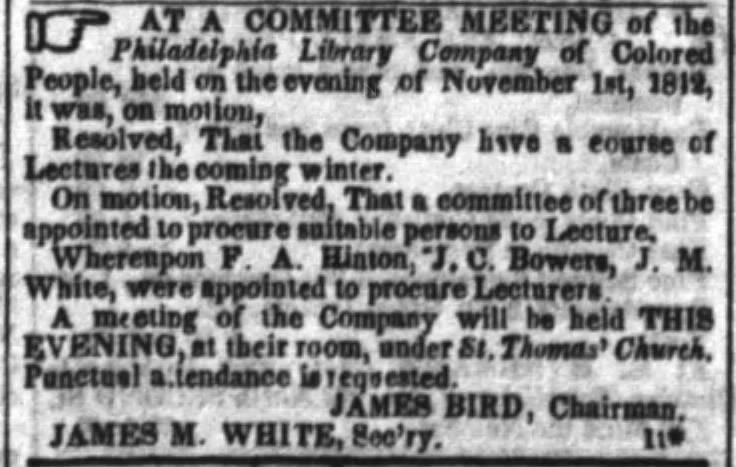
What is this notice telling us? There is a Committee. A Chairman. A Secretary. A sub-committee of three to procure lecturers. A standing meeting space - their room, under St. Thomas' Church.
This is institutional architecture.
A year earlier, in 1841, the same Library Company hosted a Grand Concert at St. Thomas. The handbill is extraordinary - read what the Library Company tells its public the evening is for:
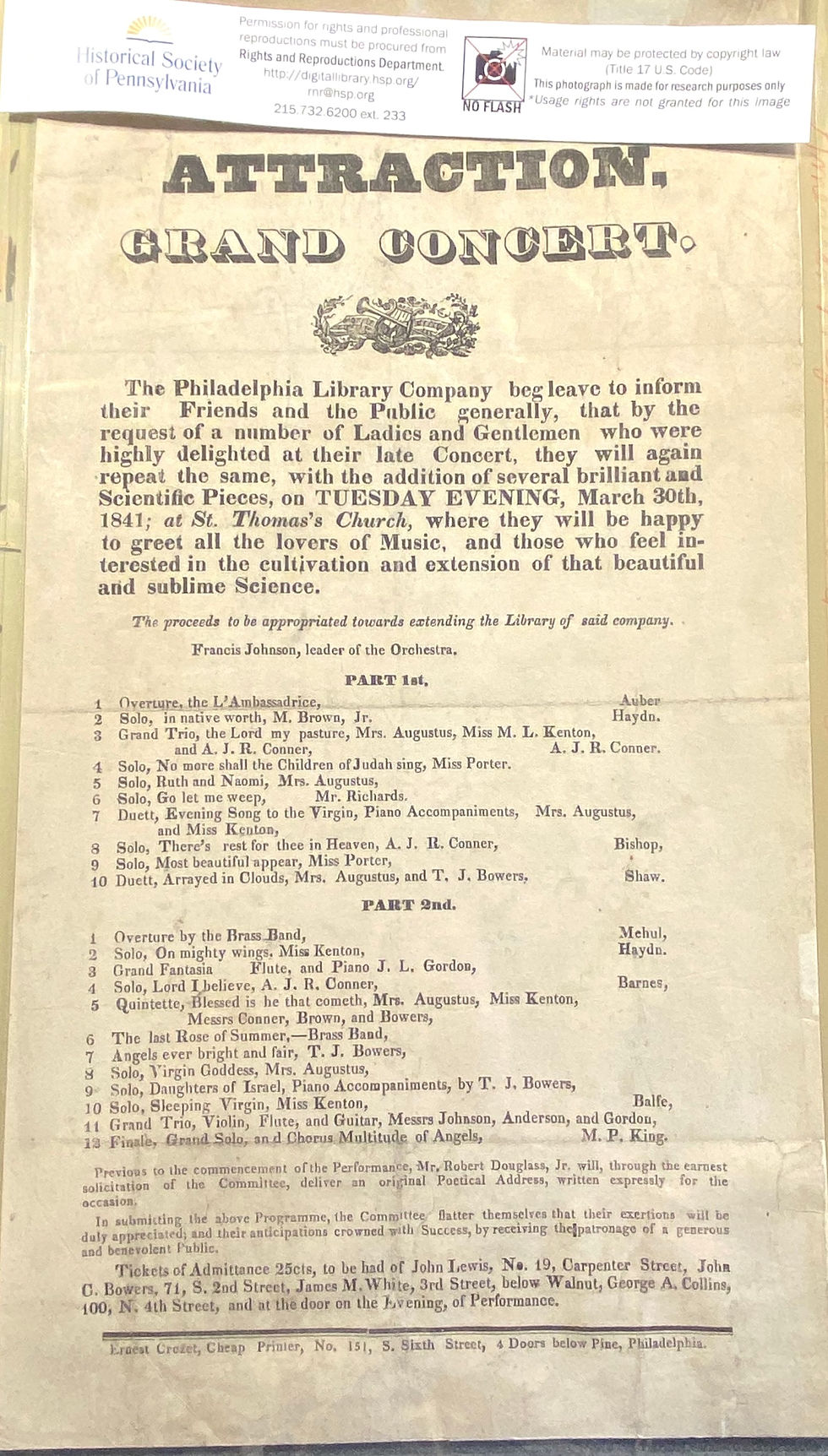
Music. Science. Cultivation and extension.
The proceeds go to the Library. Francis Johnson leads the orchestra - Philadelphia's preeminent Black bandleader and composer, the man who took a Black ensemble to perform for Queen Victoria.
A library. A concert hall. A lyceum. A music-and-science evening with one of the era's great composers on the podium. All running out of one church.
While the Black Library Company was running lectures and concerts at St. Thomas, something else was happening just a few blocks west - at the city's premier science museum.
1840 - A Telescope at the Franklin Institute, in Three Acts
This is the case study. Stay with us, because it sets up everything that follows.

Act One: The Announcement
On Wednesday, October 7, 1840, the Public Ledger printed a notice on page 2 under the heading "Unusual Mechanical Genius":
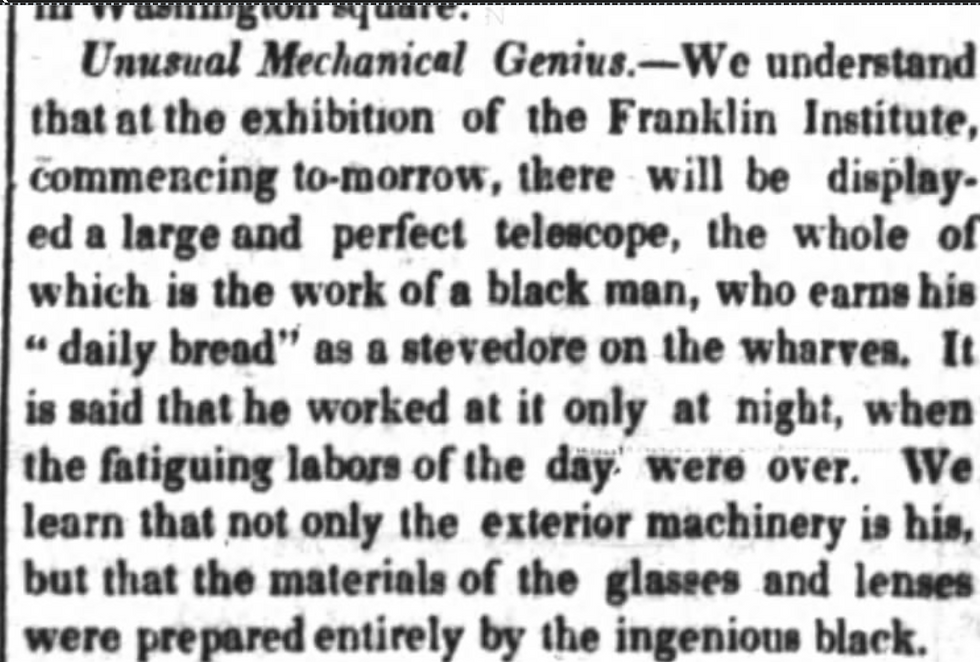
The paper is praising the telescope. It is also racially stereotyping the maker before it names him - a black man, a stevedore, the ingenious black. These are all assumptions based on race. The reality is that Robert B. Forten was a wealthy man - the son of sailmaker James Forten.
The praise is real. The biased objectification - the assumption of poverty - is also real and something we notice alot in the historiography.
Act Two: The Correction
The next day, Thursday, October 8, 1840, the Public Ledger corrected itself:

Now he has a name. Now he has a firm. Now the language is intelligence, respectability, success. From "the ingenious black" on Wednesday to "Mr. Robert B. Forten" on Thursday. I imagine that the Fortens had a strongly worded conversation with the editors the previous night. They were powerful enough in Philadelphia that the city's paper of record corrected itself within twenty-four hours.
Robert Bridges Forten, by the way, was no accidental scientist. Son of James Forten, abolitionist, sailmaker, one of the wealthiest Black men in America.
The telescope was a nine-foot Newtonian. He ground and polished the lenses himself.
Act Three: The Non-Judgment
On Monday, December 14, 1840, the Philadelphia Inquirer reported on the Franklin Institute's annual exhibition awards.
Pages of awards. The Committee judged Fine Arts. Silver Ware. Plated Goods. Book Binders' Work. Marble and Statuary. Chemicals. Philosophical Apparatus. Surgical Instruments. Copper and Brass. Japanned Work. Plated and Steel Saddlery. Guns. Boots and Shoes. Fancy Goods. Silver medals to firms. Certificates of honourable mention to apprentices. A silver medal to a fourteen-year-old named Augustus Brookfield for a miniature marble monument.
The judges were judging. The Committee was committee-ing.
And then, in the middle of the report:

The weather. 🤔
The judges judged everything else. The judges judged the friction matches and the dental instruments and the pickles and the boy's miniature marble monument.
They could not judge the telescope?
This is not a slammed door. It is a procedural drift. It is referred to the Committee on Science and the Arts. It is a referral that ends nowhere we can find.
A note on the Scott Medal: we had originally read, from a secondary source, that Forten won the Franklin Institute's Scott Medal for this telescope. The published record from December 1840 indicate that, in fact, that his telescope was not judged at all.
1841 - What Black Philadelphia Imagined Doing With the Telescope
Four months after the non-judgment, on April 3, 1841, the Colored American printed a notice from D. A. Payne - Daniel Alexander Payne, African Methodist Episcopal minister and educator.

Future Bishop. Future president of Wilberforce. The man who, as Biddle and Dubin remind us in Tasting Freedom, had been half-blinded by his own curiosity about the 1832 solar eclipse. Payne looked at the sun and had a life-long partial loss of sight for it.
In the Colored American, Payne laid out a vision. A Male and Female Seminary. Read the curriculum:
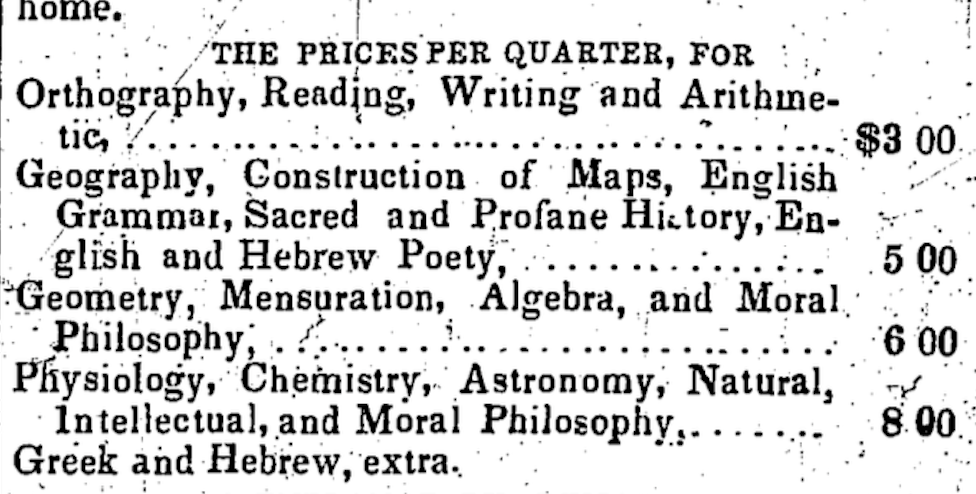
Astronomy. Chemistry. Algebra. Greek. Hebrew. Moral Philosophy. This is liberal arts higher education, designed for Black students, in 1841, in Philadelphia.
Payne tells the reader that advanced scholars will be taught to keep an Index Rerum -the scholar's commonplace book, the disciplined research notebook of a serious thinker.
He explains his choices. They have "introduced the study of Poetry, not with the hope of making poets, but for the purpose of giving a right direction to their literary taste, and an elevated tone to their moral sensibilities." The reading list includes Cowper, Thomson, Young, Pollock, Milton, David, Job, and Isaiah. Payne is putting Milton and the prophets in the same syllabus. He knows exactly what he is doing.
And then -

whenever a class can be formed for that purpose.
We want to be careful here, because Payne does not appear, in his autobiography, to have actually run this seminary in 1841.
Black newspapers in this period regularly printed visions of what could be - poems imagining freedom, songs imagining new worlds, proposals for institutions that did not yet exist.
The April 1841 notice in the Colored American reads, on careful inspection, as perhaps one of those visions. A published proposal. A community ask.
And the vision is specific. Payne had spoken with Forten. Forten had agreed. The instrument existed. The teacher existed. The curriculum existed on paper. What was missing was the institutional container - whenever a class can be formed.
So in December 1840, the Franklin Institute will not examine Robert Forten's telescope. Weather.
But by April 1841, Robert Forten has agreed to deliver lectures on astronomy and give Black students telescopic views of the heavens - as soon as a class can be formed.
The white institution displayed the instrument, refused to evaluate it, and would not have admitted its maker through the front door. The Black community - through a Black newspaper, an AME minister, and a published curriculum - was already imagining the institution that could.
September 1848 - A Wax Last Supper and a Resolution at Brick Wesley
We're going to step away from the telescope for a moment. Stay with us - it comes back.
Now we're at the Assembly Buildings, on a September evening in 1848. There is an exhibition of wax statuary - "The Last Supper" and "The Trial and Crucifixion of the Saviour." Admission 25 cents.
Black people are asked to come on two days “set apart” for them.

A wax exhibition of The Passion of the Christ.
Restricted by color line. Two days "set apart for them" - Friday and Tuesday. The other five days, presumably, set apart for everyone else.
When the Pennsylvania Freeman covered a protest of the exhibit a week later, the paper named exactly what was happening

That sentence is doing a lot of work. None of Christ's dark-browed brethren were admitted. Against whose money they felt no prejudice.
The Freeman is showing you, in 1848, that this exclusion was understood at the time as a contradiction - religious, theological, commercial - and that the Black press was sharp enough to name every layer of it.
Black Philadelphia called a meeting. At a church - Brick Wesley Church.
On Thursday evening, September 21, 1848, a large meeting adopted a unanimous resolution against the exhibit.
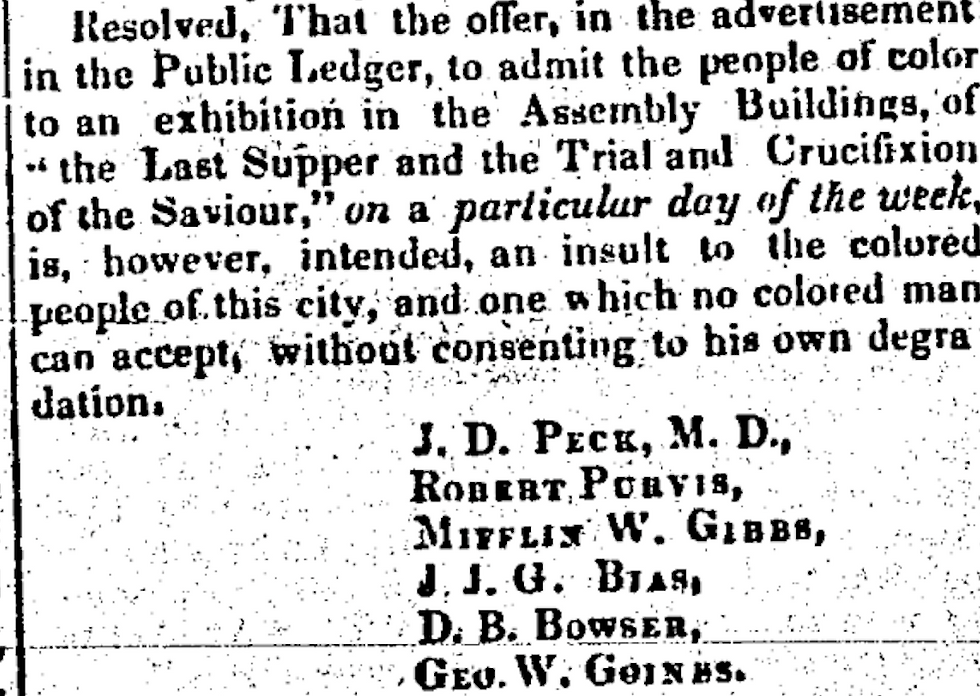
The Freeman ran it under the headline "Violent Spasm of Colorphobia."
And then - this is the part you can't make up -the proprietors of the wax exhibition responded in print. They put their reasoning in a Philadelphia daily.
The Freeman reprinted it in full, calling it an "ill-natured exhibition of their chagrin and anger at the manly answer of the colored people."

Appreciate a privilege? Without seeking to force themselves into a white audience?
This is the institution telling on itself. That is what cultural-institutional racism in 1848 understood about itself. It considered itself to be the bestower of a privilege, expecting gratitude, enraged by the suggestion that admission to a public exhibition might be a right rather than a favor.
Brick Wesley - a church - was, once again, the venue for civic life - this time for civic protest against exclusion in public cultural institutions.

December 6, 1848 - The Vision Lands in the Boardroom
Three months later.
A group of Black community members walked into a meeting of the Managers of the Institute for Colored Youth and made a proposal.
ICY was, at that point, a trade school. White Quakers had founded it in 1837. It taught Black boys mechanical trades. It was not yet the institution it would become - not yet the place where Charles L. Reason and Ebenezer Don Carlos Bassett and Octavius V. Catto would teach.
The historian Charlene Conyers was the first to surface what happened in that managers' meeting. Read the minutes:
"Then the visitors made a suggestion which was to have far-reaching results. They indicated that the matter of a literary education was as important to Negroes as that of learning a trade and suggested that the apprenticed lads would be better qualified if they also had a '... knowledge of the higher branches ... which would enable them to carry on their business more successfully and eventually to be prepared to instruct others in like manner.'
Conyers, Charline Howard. (1961). A History of the Cheyney State Teachers College, Page 100
The message: Literary education is as important as a trade. The higher branches. Eventually to be prepared to instruct others in like manner.
That is the Payne argument from April 1841. Almost verbatim in spirit. A vision of rigorous and robust Black higher education.
Payne knew the abolitionist and educational circles of Black Philadelphia. And this included Stephen Gloucester, Peter Lester, Nathaniel Depee, James Bustill, JP Burr and Morris Brown. These men were almost certainly drawn from the same network that had published Payne's vision in 1841 and gathered at Brick Wesley three months earlier.
Look at what Black Philadelphia was doing in 1848.
In September, 1848: publicly protesting cultural institution exclusionary practices.
In December, 1848: persuading ICY's white managers to add higher education.
They were doing both at once - refusing the terms of exclusion and building the terms for inclusion.
It worked for ICY at least.
Within a few years, ICY would shift. The "higher branches" Payne had imagined in 1841 became the actual curriculum at ICY in the 1850s. The faculty group portrait we'll look at in a few sections exists because of conversations like this one. The institution had not been pushed by the trustees. It had been pushed by the community. By visitors. In a managers' meeting. In December 1848.
The vision Payne had printed in a Black newspaper in 1841 - whenever a class can be formed -finally had a place where the class could be formed.
1851 - The Colored Mechanics Fair
By 1851 Black Philadelphia was building it's own exhibits and celebrating its own inventors. The Colored Mechanics Fair was a three day celebration of ingenuity and inventiveness. When placed in context of public institution exclusion and racism, we imagine that it was a way to both provide a positive affirming experience for Black inventors (in contrast to Forten's experience) and to build muscle and know how for Black scientifc fair work.
1852 - Wonders of the Microscopic World
While ICY was beginning its slow shift toward higher education, the churches kept doing what they had always done.
Taking the place of the cultural institutions that were actively excluding Black people.
They were becoming the museums.
November 9, 1852. An ad in the Public Ledger:

A church is hosting a science demonstration. The hydro-oxygen microscope - a projection microscope that used light to throw a massively magnified live image of microscopic specimens onto a screen - was cutting-edge optical technology in 1852.

Audiences saw the structure of insects, plant tissues, drops of pond water teeming with organisms. It was scientific entertainment of the highest order, the kind of demonstration public scientific institutions were built to host.
Ten cents. Open to the public. Benefit of the church.
In the same city, in the same year, the Franklin Institute and the Academy of Natural Science were open to white visitors only.
1853 - The Chinese Museum
In 1853, Robert Purvis's son escorted two young women to an exhibit at the Chinese Museum in Philadelphia. The young women were Sarah Remond of Salem and Annie Wood.
Stay with the names, because the family connections matter and they keep recurring.
Annie Wood was the sister of Mary Virginia Wood Forten -wife of Robert Bridges Forten, the man who ground the telescope lenses in 1840.

Their daughter was Charlotte Forten Grimké, whose diary gives us a rare glimpse into daily Philadelphia life in the 19th century.
So this is the wife of the telescope-maker. And it's her sister who is being turned away.
Sarah Remond was a member of the famous Salem, Massachusetts Remond family -herself an emerging anti-slavery lecturer who, within a few years, would be touring Britain and Ireland speaking before audiences of thousands.

They were turned away from the Chinese Museum solely because of their color.
The Purvis' sued in alderman's court. They lost. (Bacon, Page 111)
1856 - The Very Emphatic Reply of 'Color'
Now back to ICY. Because the institution that came out of that 1848 boardroom meeting was, by 1856, producing the intellectual leadership of Black Philadelphia.
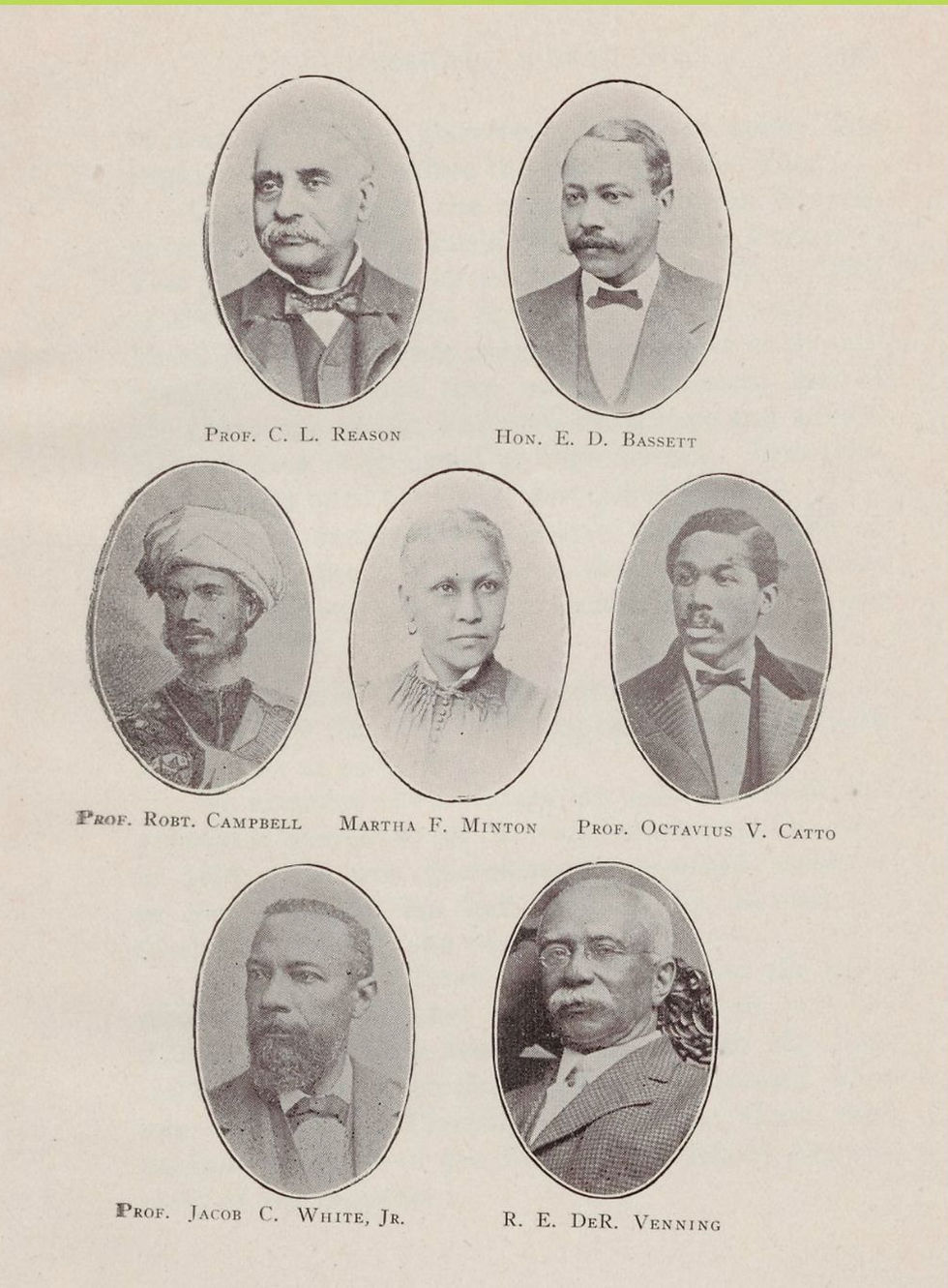
Look at this faculty.
Charles L. Reason - mathematician, poet, the first Black professor at a predominantly white college in the United States.
Ebenezer Don Carlos Bassett - Principal of ICY, who would go on to become the first Black American diplomat, U.S. Minister to Haiti.
Martha F. Minton - Educator. One of the first female graduates of the Institute for Colored Youth
Octavius V. Catto - The man who would lead the desegregation of Philadelphia's streetcars and be assassinated on Election Day 1871 at age 32.
Jacob C. White, Jr. - Philadelphia's first Black principal, Roberts Vaux School, civic leader.
R. E. DeR. Venning - Educator.
And Prof. Robert Campbell in his turban, second row, far left.
This is the intellectual leadership of Black Philadelphia in the mid-19th century, sitting together in one frame. This is the faculty that the 1848 visitors made possible.
In November 1856, Professor Robert Campbell tried to buy a season ticket to the Franklin Institute's public lecture series. The Institute had run a public advertisement for it. He complied with its terms. Here is what he writes to the Managers of the Franklin Institute, in his own handwriting, in a letter now held at the Friends Historical Library of Swarthmore College:
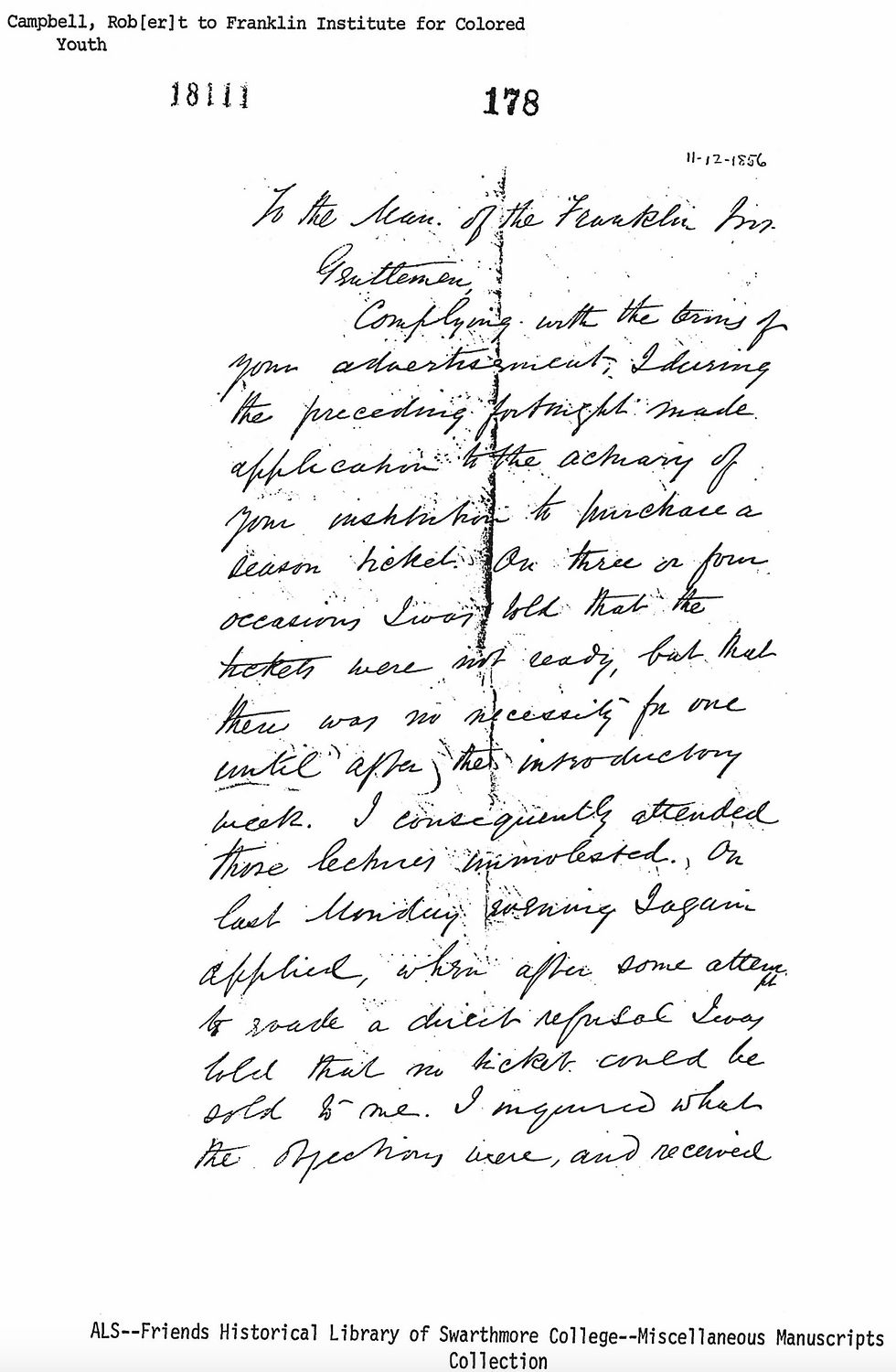
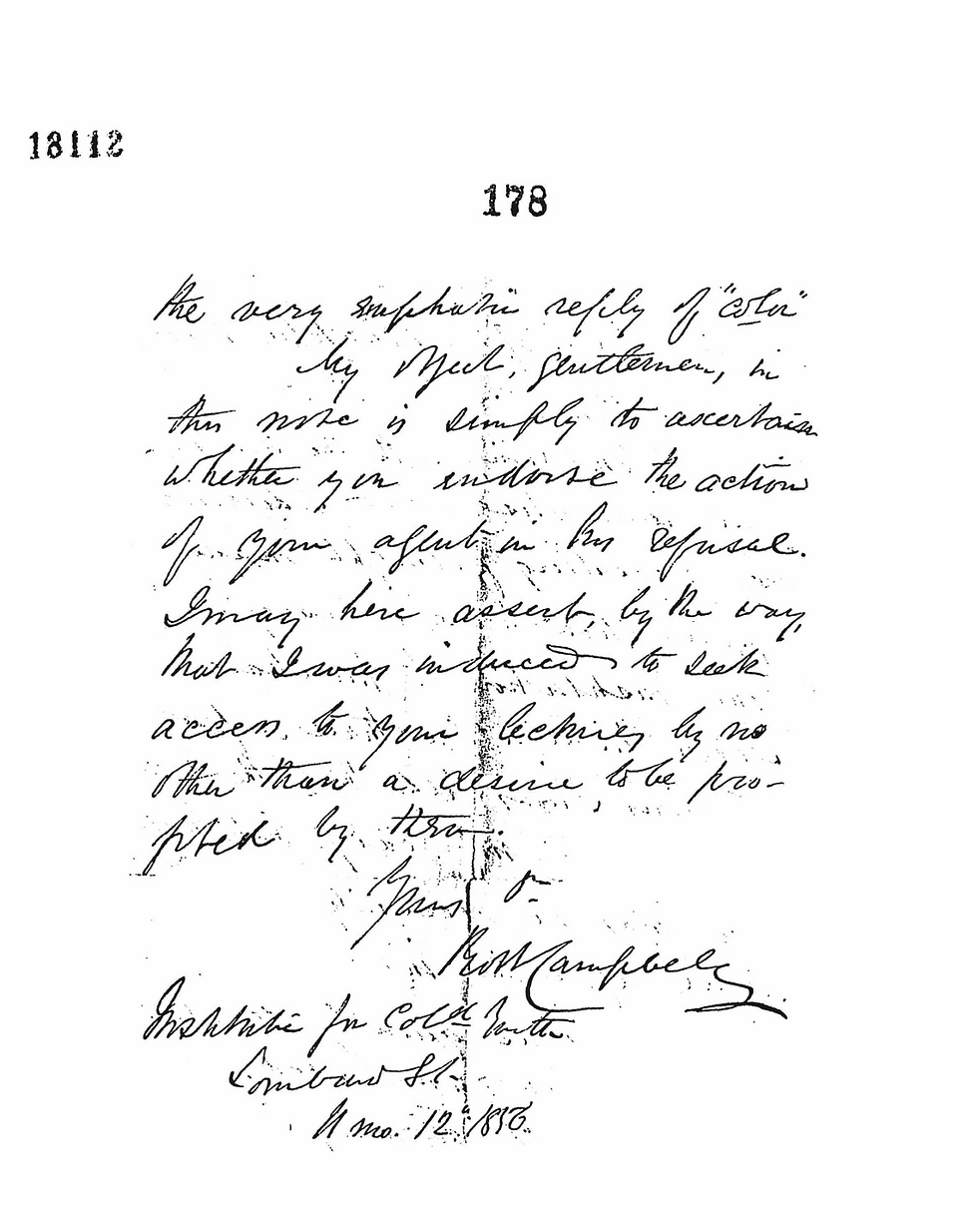
"To the Man[agers] of the Franklin In[stitute] Gentlemen, Complying with the terms of your advertisement, I during the preceding fortnight made application to the actuary of your institution to purchase a season ticket. On three or four occasions I was told that the tickets were not ready, but that there was no necessity for one until after the introductory week. I consequently attended those lectures unmolested.
On last Monday evening I again applied, when after some attempt to evade a direct refusal I was told that no ticket could be sold to me.
I inquired what the objections were, and received the very emphatic reply of 'color.'
My object, gentlemen, in this note is simply to ascertain whether you endorse the action of your agent in his refusal. I may here assert, by the way, that I was induced to seek access to your lectures by no other than a desire to be profitted by them. Yours &c., Rob[er]t Campbell, Institute for Col[ored Youth], Lombard St. 11 mo. 12 1856."
He complied with the terms. He showed up three or four times. He attended the introductory lectures - unmolested, his word, with all the resignation built into it. He applied again. They evaded. They refused. He asked why. And the answer was: the very emphatic reply of 'color.'
His closing line: "I was induced to seek access to your lectures by no other than a desire to be profitted by them."
A teacher of science. Wanting to attend a science lecture. To learn from it. In his own city.
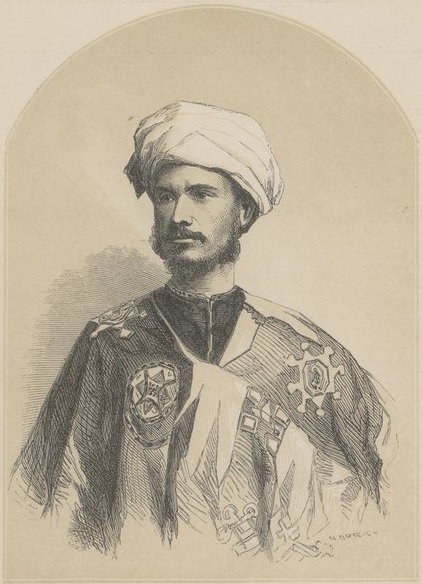
The Franklin Institute refused to accept him in 1856 for the same reason it had refused to evaluate Forten's telescope in 1840.
Sixteen years. Same pattern. Different scientist.
1856 - A Telescoping Fire Apparatus
In 1856, Aaron Roberts, of Philadelphia, submitted to the Franklin Institute's Committee on Science and the Arts a Model of an Apparatus for Extinguishing Fires.
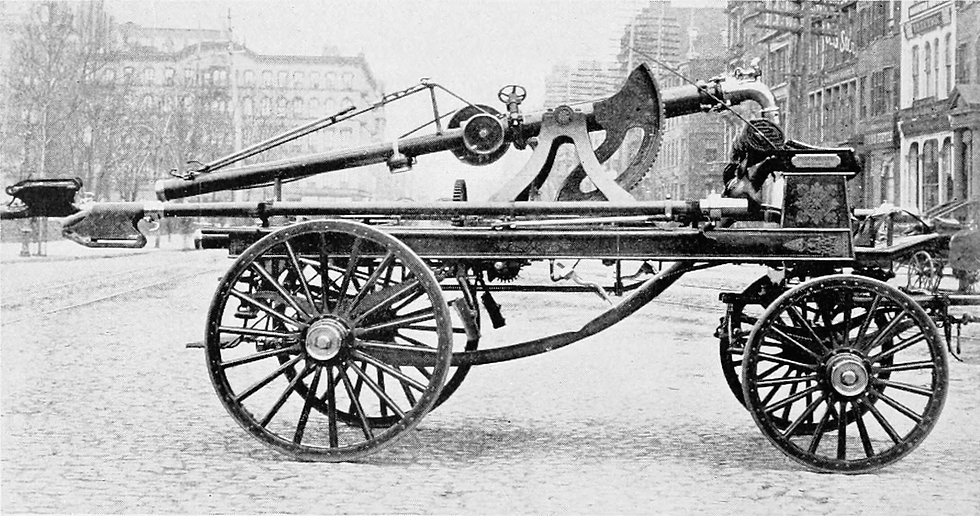
The Committee's published report describes the device in technical detail. They called it ingenious. They said it would supersede the ladder.
It is worth quoting at length because the writers know exactly what they are looking at:

And then - per the Encyclopedia Britannica, New Werner Edition - "the first designs for a water tower were made by Aaron Roberts, a colored man of Philadelphia, in 1857, but none were ever constructed from this design."

The credit went to John S. Logan of Baltimore.
Ingenuity acknowledged. Design shelved.
1859 - So That They May Be Seen
Three years after his apparatus had been reviewed at the Franklin Institute and never built, Aaron Roberts wrote a letter to the Banneker Institute of Philadelphia.
Within five years of its founding it had established a reputation as a clearinghouse for racial matters and a meticulous record-keeping practice. (Martin)
Roberts wrote to them in 1859 because - in his own words -
"as your object is to keep Records of all the inventions that [are] got up by our people so that they may be seen." (Martin)
Aaron Roberts knew. He knew that white-run institutions in Philadelphia would not preserve his name. So he submitted himself to a Black-run institution that would.
The vocabulary keeps recurring. Records. Higher branches. To be seen. To instruct others.
Black Philadelphia is, across nearly two decades, working out the same problem in the same words: how do we preserve our own. How do we credit our own. How do we transmit forward what the city refuses to evaluate.
The answer is consistent. Build our own.
1897 - Stereopticon Civil War History
Decades pass. The Civil War. Emancipation. Reconstruction. Reconstruction's collapse.
The churches keep doing the work. They keep acting as the memory keepers, the history tellers, the scientific explorers - the museum.
April 30, 1897. First African Presbyterian Church. 17th and Fitzwater. A card announces:
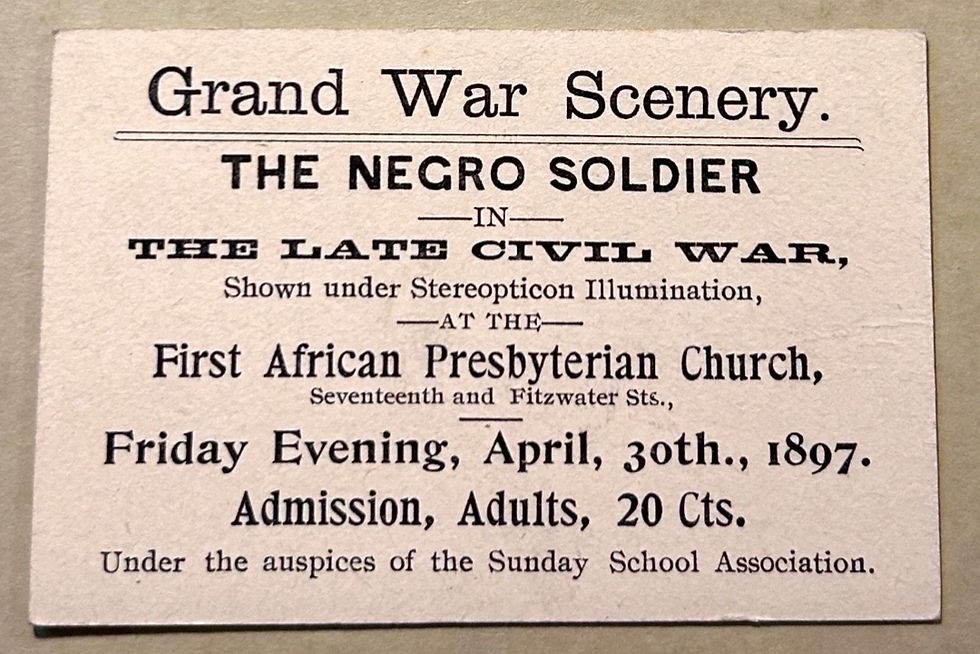
Thirty-two years after Appomattox. The country is well into the period historians now call the Lost Cause - when Confederate veterans' associations, popular textbooks, statuary committees, and mainstream museums are coordinating, in plain sight, the erasure of Black narratives from the Civil War's story. Statues of Confederate generals are going up.
And meanwhile, in a Black church at 17th and Fitzwater, the Sunday School Association is mounting a multimedia historical exhibition. Grand War Scenery. The Negro Soldier in the Late Civil War. Shown under stereopticon illumination - the era's projected-image technology, the closest 1897 thing to cinema.

This is a multimedia history exhibition. In a church. In 1897. Refusing the Lost Cause in real time, with projected images, twenty cents at the door.
The same instinct that had Daniel Payne wanting to point Forten's telescope at the sky in 1841 has, by 1897, projected an entire visual history of Black Civil War service onto a church wall.
Sixty-four years later.
1908 - Mother Bethel Founds a Museum
And then, eleven years after the Grand War Scenery, the work becomes formal. And named.
August 10, 1908. The minutes of the Allen Guard at Mother Bethel AME Church record a speech by Mr. M. G. Johnson - who "spoke at length on the lack of a history of our church, saying in part it is time that we began to gather in this church pictures and historical relics of the founders of the A.M.E. Church." Then this resolution:

The vocabulary is all museum. Collect. Care for. Preserve. Articles of historical value. A room. To be known as. Museum.
A committee. A collections mandate. A defined collecting scope. A named museum. Inside a Black church.
In 1908, long before the founding of any of the institutions we now think of when we say Black history museum, Mother Bethel had one.
Note the AME connection. Daniel Payne, who had imagined a Black higher education with astronomy and Greek in 1841, became a Bishop of the AME church.
And it is the AME church, two generations later, that founds the Allen Historical Museum. The same denomination that had aspired to higher learning in Payne's vision is now formally aspiring to keep its own history.
ca. 1910 - The Children of Mary Virginia Wood's Family
Last image. We end here, because of what it means.

These are children related to the Wood-Webb family - Mary Virginia Wood's people.
This portrait now lives in the Library Company of Philadelphia.
The Library Company of Philadelphia, in the 19th century, was the white Library Company. The Black Library Company - the Philadelphia Library Company for Colored Persons - was a separate institution, founded in 1833, operating out of the basement of St. Thomas Church. Two parallel institutions, segregated by race, in the same city, for most of the 19th century.
The Two Timelines, Together
Here is what we want you to carry away from the walk.
Year | Inside the Black church / Black institution | Inside the public cultural institution |
1833 | Black Philadelphia Library Company housed at St. Thomas | The white Library Company of Philadelphia operates separately |
Oct 1840 | Robert Bridges Forten's nine-foot Newtonian telescope displayed at the Franklin Institute exhibition | |
Dec 1840 | The Franklin Institute declines to judge the telescope; cites the weather; refers it to the Committee on Science and the Arts | |
Mar 1841 | Grand Concert with "Scientific Pieces" at St. Thomas, Francis Johnson conducting | |
Apr 1841 | Daniel Payne publishes his vision for a Black Male and Female Seminary in the Colored American; Robert Forten has agreed to teach astronomy with telescopic views whenever a class can be formed | |
Nov 1842 | Library Company winter lecture series at St. Thomas | |
Sept 1848 | Brick Wesley Church hosts the citywide protest meeting against the segregated "colored day" at the wax statuary exhibition | Wax Statuary "Last Supper" exhibition at the Assembly Buildings restricts Black admission to two segregated days; proprietors publicly defend exclusion as a "privilege" |
Dec 1848 | Visitors persuade the ICY Managers to add higher education for Black students | |
1852 | Hydro-oxygen microscope exhibition at Shiloh Baptist | |
1853 | Sarah Remond, Annie Wood, and Robert Purvis Jr. turned away from the Chinese Museum; the Purvises sue and lose | |
1856 | Prof. Robert Campbell denied a Franklin Institute season ticket with "the very emphatic reply of 'color'"; Aaron Roberts's fire apparatus reviewed and praised by the Franklin Institute but never built | |
1859 | Aaron Roberts submits his invention to the Banneker Institute "so that they may be seen" | |
1897 | Stereopticon Negro Soldier in the Late Civil War exhibition at First African Presbyterian | |
1908 | Mother Bethel founds the Allen Historical Museum | |
ca. 1910 | Wood-Webb family portrait taken; now held by the Library Company of Philadelphia |
Black churches and Black literary societies were doing the work of museums, libraries, science halls, and historical societies - continuously, decade after decade - while the white-run institutions were extracting Black intellectual labor (telescopes, fire apparatus designs) and denying Black bodies access (Campbell, Purvis Jr., Remond, Wood).
The pattern of exclusion is consistent across every kind of institution. Science museum. Commercial wax exhibition. Lecture series. Cultural museum. Same rules at every door.
And the response, also consistent: build our own. Preserve our own. Keep records of all the inventions got up by our people so that they may be seen.
What This Means for How We Talk About Museums
When people in 2026 ask when Black museum work in Philadelphia began, they often point to mid-20th century institutions. Those institutions are extraordinary. But they are not the beginning.
The beginning was 1833. In a church basement.
The beginning was Daniel Payne in 1841 imagining Black students looking through Robert Forten's telescope.
The beginning was the visitors who walked into the ICY Managers' meeting in December 1848 and argued for the higher branches.
The beginning was the 1852 microscope demonstration at Shiloh. The 1897 stereopticon Civil War exhibition at First African. The 1908 founding of the Allen Historical Museum at Mother Bethel.
And the beginning was also the September 1848 resolution at Brick Wesley - the moment Black Philadelphia stood up in a church and refused to appreciate a privilege of being allowed into a white audience for a wax exhibition of the Crucifixion.
There were always museums in Black Philadelphia. There were always libraries.
They were inside the churches and literary societies. That is where the earliest Black museum is. That is where it has been all along.
Thanks for walking with me as we restore and keep record.
So that they may be seen.
End Notes:
Exclusion from public institutions in Philadelphia began to lift around 1870 when Frederick Douglass wrote a scathing letter about racism at the Academy of Music.
Philadelphia is rich with Black museums today - here's a great list from Visit Philly.

Sources
Primary sources — the Forten telescope arc
Public Ledger (Philadelphia), October 7, 1840, p. 2. "Unusual Mechanical Genius." Newspapers.com.
Public Ledger (Philadelphia), October 8, 1840. Correction notice identifying Robert B. Forten as the maker of the telescope. Newspapers.com.
Philadelphia Inquirer, December 14, 1840, p. 2. Report on the Franklin Institute's annual exhibition awards, including the notice that the Forten and Pakerson telescopes "could not be examined during the exhibition" and were referred to the Committee on Science and the Arts. Newspapers.com.
Primary sources — the Black higher-education arc
Colored American, April 3, 1841. D. A. Payne, "Male and Female Seminary — Rules / Prices / Explanatory Remarks," including the announcement that Robert Forten will deliver lectures on Astronomy and give pupils telescopic views of the heavens. Courtesy Center for Research Libraries
Managers' Meeting Minutes of the Institute for Colored Youth, December 6, 1848, surfaced by historian Charlene Conyers. Conyers, Charline Howard. (1961). A History of the Cheyney State Teachers College, 1837-1951. Ann Arbor: University Microfilms. Digitized by Friends Historical Library https://digitalcollections.tricolib.brynmawr.edu/collections/4059rihu
“Fanny Jackson Coppin. Reminiscences of School Life, and Hints on Teaching.” 1912 https://docsouth.unc.edu/neh/jacksonc/ill7.html.
Robert Campbell to the Managers of the Franklin Institute, November 12, 1856. Proquest Black Abolitionist Papers, 1830–1865, Friends Historical Library of Swarthmore College.
Primary sources — exclusion and protest
Public Ledger (Philadelphia), September 22, 1848. Notice of segregated days for the "Last Supper" and "Trial and Crucifixion of the Saviour" wax exhibition at the Assembly Buildings. Newspapers.com.
Pennsylvania Freeman, late September 1848. "Violent Spasm of Colorphobia," including the Brick Wesley Church resolution of September 21, 1848.
"Racist response by Wax Statuary exhibition" Newspapers.com, Public Ledger, September 26, 1848, https://www.newspapers.com/article/public-ledger-racist-response-by-wax-sta/197617985/
Forten, Mary Virginia Wood, "Poetry and Autographs Album Belonging to Mary Virginia Wood" (1834). Howard University, Moorland Spingarn Research Center.
Primary sources — Black institutional cultural work
Public Ledger (Philadelphia), November 8, 1842. Committee meeting and lecture series notice for the Philadelphia Library Company of Colored People at St. Thomas Church.
Handbill, "Attraction. Grand Concert," Philadelphia Library Company at St. Thomas Church, March 30, 1841. Leon Gardiner Collection, Historical Society of Pennsylvania.
Public Ledger (Philadelphia), November 9, 1852. Advertisement for "Wonders of the Microscopic World" at Shiloh Baptist Church.
Handbill, "Grand War Scenery. The Negro Soldier in the Late Civil War." First African Presbyterian Church, April 30, 1897. Historical Society of Pennsylvania.
"Historical Commission — Extract From the Minutes of the Allen Guard, August 10, 1908." In Centennial Historical Souvenir of "Mother" Bethel African Methodist Episcopal Church, Philadelphia, Pa., ed. Charles Simpson Butcher, Richard R. Wright, and the Pennsylvania Historical Commission. Philadelphia: Historical Society, 1916.
The New Werner Twentieth Century Edition of the Encyclopaedia Britannica: a Standard Work of Reference In Art, Literature, Science, History, Geography, Commerce, Biography, Discovery And Invention ... With New American Supplement, Complete In Thirty Volumes. Akron, Ohio: Werner Co., 1905.
Portraits and photographs
Robert Campbell ("emigrant to Lagos"), engraved portrait.
Institute for Colored Youth faculty group portrait: Prof. C. L. Reason, Hon. E. D. Bassett, Prof. Robt. Campbell, Martha F. Minton, Prof. Octavius V. Catto, Prof. Jacob C. White Jr., R. E. DeR. Venning.
Benjamin J. Fowler studio portrait of Wood-Webb children, ca. 1910. Wood-Webb Collection, Library Company of Philadelphia (P.2022.42.79).
Fire Apparatus. Courtesy Wikisource: Popular Science Monthly Volume 47 September 1895.
Secondary sources
Bacon, Margaret Hope. But One Race: The Life of Robert Purvis. State University of New York Press, 2007
Conyers, Charline Howard. (1961). A History of the Cheyney State Teachers College, 1837-1951. Ann Arbor: University Microfilms (originally submitted to New York University in 1960)
Martin, Tony. "The Banneker Literary Institute of Philadelphia: African American Intellectual Activism Before the War of the Slaveholders' Rebellion." The Journal of African American History, vol. 87, 2002, pp. 303–322.
Wells, Kentwood. "Fleas the Size of Elephants: the Wonders of the Oxyhydrogen Microscope", The Magic Lantern Gazette; A Journal of Research. Volume 29, Number 2/3 Summer/Fall 2017.
Collection credits
Historical Society of Pennsylvania
1841 Library Company for Colored Persons Concert with Scientific Pieces at St. Thomas https://digitallibrary.hsp.org/Detail/objects/19979
1893 Spelling Bee (Public Programming) at First African Presbyterian https://digitallibrary.hsp.org/Detail/objects/19977
Library Company of Philadelphia — Wood-Webb Collection
National Museum of African American History and Culture (NMAAHC)
Friends Historical Library of Swarthmore College — Black Abolitionist Papers
William Henry Dorsey Collection, Cheyney University (housed at Penn State)
Accessible Archives — Colored American