



Finding the Boyer House Mob Attack and Righting the California House: Black Self-Defense in 1849 Philadelphia

Updated: Jul 27
How a forgotten attack in August 1849 rewrites the story of Philadelphia's California House riot - and reveals fifteen years of Black self-defense hiding in plain sight.
"What is to be Done? Retreat and be Murdered or Defend your Life?"
Black citizens of St. Mary's Street, in the Public Ledger 8/20/1849
On a hot day in August - August 14, 1834 - Charles Akers surveyed his ruined home and decided he was going to press charges. He knew who had come into the house and destroyed it: his furniture broken, his windows smashed, the sashes knocked off his doors. He might have paused over the fact that he was a Black man about to walk into a public office and claim that a white man had wrecked his home - and to ask for justice.

But before long he was leaving the house, crossing Washington Square, and walking into the mayor's office at Independence Hall. He stepped up to the desk and stated that Terence O'Neill (also spelled O'Neal) had destroyed his home. The clerk entered it in the book. Some time later, Terence O'Neill's name appeared in the Prisoners for Trial docket.

Fifteen years after Akers sought justice, a Black tavern keeper named Samuel Williams stood inside his own barroom at Seventh and Lombard with a warm, loaded, double-barreled gun - having just driven a white mob back across South Street.
A Black man using the machinery of criminal justice to protect himself in 1834 had become, by 1849, a Black man garrisoned in his own tavern against attack by white mobsters. In the inability of Philadelphia to protect a Black citizen in this space lies the story that follows. Black citizens, therefore, protected themselves.
The Hidden Mob Attack
For as long as it has been remembered, the California House attack of October 1849 has been told as a small story. Benjamin Jackson, a Black man, owned a tavern at Sixth and St. Mary Street. He was married to a white woman. On election night, a white mob burned the tavern and set off a street battle that raged for the better part of two days. The explanation, then and ever since: a mob enraged by an interracial marriage.

That explanation was one reason, but definitely not the main reason for the attack.
While researching Samuel Williams, an Underground Railroad conductor who sheltered freedom seekers in his home, a newspaper account turned up describing an attack on his tavern, the Boyer House - on August 18, 1849, two months before the California House and one block away.

Most histories have missed it entirely. And the account was full of Black people defending themselves: with guns, in the street, in the courtroom.
Which raised a question that would not go away. If this much self-defense was visible in one forgotten article, how much more was in the record? The answer, it turned out, reached back to Charles Akers. But first, the Boyer House.
August 1849: The Stand at the Boyer House
The defense began the day before the attack. Word was moving through the neighborhood that the Killers - the Irish gang that ran the streets of Moyamensing, the district just south of South Street - were coming. Witnesses later said weapons were seen being carried into the Boyer House; a woman named Martha Dunlap would be charged with bringing them in.

Around the corner on St. Mary Street, the California House was seen taking in bricks. The community was not waiting to be surprised. It was provisioning garrisons.
On the night of August 18, the Killers crossed South Street and came up Seventh toward the Boyer House. Samuel Williams was inside, with his nephew Alfred Turner and a handful of other men. Williams was no novice; he had been arrested for defending the community during the mob attack of 1842.
When the gang struck, the men in the tavern fought back - and the fight went badly for the attackers. Three white men were wounded severely enough to need care, and none of them went to the hospital; the press assumed they stayed away so they would not be identified. One of them, Redman Prendible, was said to have been shot ten to fifteen times.

The Killers left in defeat, pushed back across South Street - possibly the first time that had ever happened. For a gang used to moving through the district with impunity, the Boyer House was a wall.
Then the law arrived, and the second battle started. The sheriff's men knocked down the door of Williams's tavern and found the double-barreled gun, still warm, still loaded. They began making arrests - of the defenders. And the street resisted that too. When police tried to take a man named William Sammons, a group of his friends grabbed at him, trying to pull him free; all of them were caught, and the dockets record the charges: escape, and aiding a prisoner to escape.

Others simply refused to leave when ordered - and were charged for that. One young man was arrested carrying a slingshot; another, a pistol. Around the corner, Benjamin Jackson of the California House was swept up as well, charged with assault and battery and riot.

Notice what the record shows. Refusing to disperse. Rescuing your own from the police. Carrying weapons to a garrison. Every one of these entered the docket as a crime. Every one of them was an act of defense.
And the defense did not stop at the street. A man named Elias Thompson went to the authorities and reported his white attackers by name - the same move Charles Akers had made fifteen years earlier. The community was fighting on every front at once: the tavern, the sidewalk, the station house, the clerk's book.
When the count was taken, the result was unlike anything in the previous fifteen years. There were forty arrests - quite high for a smaller mob size. Five white men and one Black man were noted in the hospital records. The mob's wounded outnumbered the defenders. No Black property destroyed. No Black man seriously hurt.
September 1849: The Verdict
The story moved into the courtroom, and there it became something new.

The Boyer House defendants - Williams, Jackson, and others - stood trial for riot in September. Their counsel argued self-defense. And before an all-white jury, they were acquitted.


Consider what that meant to the white men who had just been driven off. Black men had armed themselves, defended a Black-owned space, beaten the Killers in the street - and then walked out of the Court of Quarter Sessions free, with the law itself affirming their right to have done it. The power in the district was visibly shifting.

The Street that Saw it Coming
None of this came from nowhere, and the neighborhood had said so in print. Three years earlier, in September 1846, an appeal appeared in the paper describing the running conflicts between whites and Blacks on St. Mary Street and demanding that the city do something - warning that "if not promptly checked" the trouble would "lead to serious occurrences."

It was a charge and a prophecy in one. The appeal itself was an act of self-defense: residents using the press to build a public record and demand protection. After the Boyer House attack, they did it again - this time naming the Killers.

To see why St. Mary Street kept appearing in these stories, look at the map. By the 1840s, free Black Philadelphia was a city within a city - some 20,000 people - concentrated in the center of the metropolis, spilling across the municipal boundaries of the day. The border between Philadelphia City and Moyamensing ran along South Street.

St. Mary Street was the first street north of it - the first street a mob from Moyamensing reached when it crossed into the City, and the doorstep of a district rich with Black churches, halls, schools, businesses, and homes. There is violence on St. Mary Street in nearly every mob attack from 1834 to 1849. It was, in effect, the first line of defense.

The street was anchored by Second African Presbyterian Church - built by Black builders, "Colored Mechanics," as the church proudly advertised - burned in the 1842 attack, and rebuilt by 1845 with damages the congregation won from the county itself.⁷ The people of St. Mary Street had already learned that the courts could be made to pay for what mobs destroyed.

The Killers

Who was on the other side of that South Street border? The Killers were not a fringe gang. They were woven into Moyamensing - into its fire companies, its taverns, its aldermen, its elections. Until 1854, Moyamensing was its own municipality with its own police, and the gang moved through a world George Lippard described as "hangers-on of the law": men who clustered around aldermen's offices, traded favors, and could count on officials to look away. The gang attacking Black homes had friends inside the government.
The man who embodied that overlap was William "Bull" McMullen, who came up through the Moyamensing Hose Company - a fire company that doubled as a political machine and a street army. In 1846, facing a court date for stabbing police, he enlisted for the Mexican War. Historian Harry Silcox describes how the Killers enlisted for this war en masse and carried their disorder into the U.S. Army - brawling through an officers' election in Pittsburgh, beating policemen in New Orleans, slipping out of town before arrests could be made.
They served under the brigade command of General Robert Patterson, one of Philadelphia's wealthiest Pro-Slavery Democrats, a enslaver whose fortune was made through Southern sugar and cotton plantations. Hold on to his name.

Bull McMullen and the Killers began returning from Mexico in 1848 and by 1849 they had begun terrorizing the Black community. We imagine they did not take their defeat in August lightly.
By October 1849, the Killers had every reason to want to challenge the loss. They knew Benjamin Jackson. They knew he had been part of the August fight. They knew Black men were holding ground, pleading self-defense, and winning. The California House attack did not erupt out of nowhere over a marriage. It came after a summer in which the Killers had been beaten in the street. The target was not one household. It was Black agency itself.
October 9, 1849: The California House
Election night. The Killers loaded a tar barrel onto a wagon, set it on fire, and drove it toward St. Mary Street.

The street fought back the moment the wagon entered it. Stones came off the rooftops; pistols fired from windows. This was a predominantly Black street, but white neighbors fought too - everyone could see what a rolling barrel of fire meant on a block where Second African Presbyterian, burned once already in 1842, had just been rebuilt.

The wagon reached the California House, and a pitched battle began. Inside, Benjamin Jackson and an armed garrison fired back and held the building. A block up, at Sixth and Lombard, Black reinforcements gathered to come down and support them - and the police held them back. The mob swelled toward five hundred. When the garrison's ammunition ran out, Jackson and his men escaped out the back, and the Killers poured in, tore open the gas fixtures, and set the building alight. The fire spread down the block toward the church.
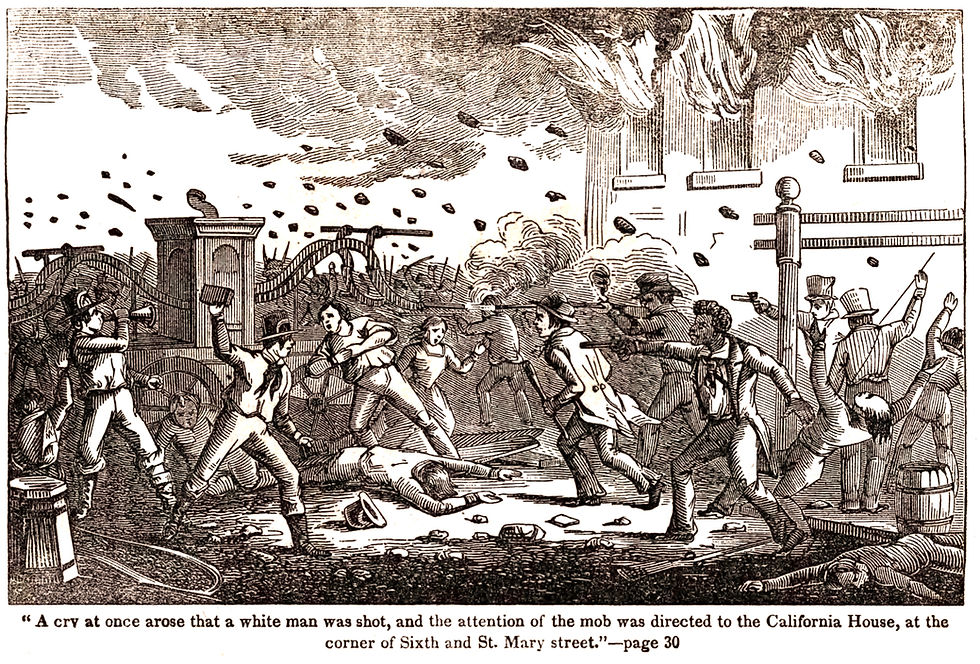
What happened next measures how much had changed. In 1842, the fire companies had stood by and let Black halls and churches burn. In 1849, they fought to save them. The Killers and members of the Moyamensing Hose cut the hoses of their rivals The Good Will Hose and stole an engine - and it was Black residents who battled to get the engine back. Good Will welcomed the help from Black residents, who carried the hoses back down St. Mary’s street so the water could reach the flames. The police, having lost the street, finally stopped holding the neighborhood back, and residents pried cobblestones out of the road to fight with.
Black self-defense kept improvising. At Mother Bethel Church, a woman named Jane Johnson had the men carry long sticks up and down the stairs past the windows, so that in the darkness the mob saw what looked like a garrison bristling with guns. The church was never attacked. And a woman named Anna Collins, whose house the mob had burned while hunting her husband, went to the authorities and reported her attackers - the Akers move, again, now fifteen years old and still working.

The night's dead tell the story of a violence that had escaped its old boundaries. Jacob Griffith, a Black seventeen-year-old, who was said to be in the employ of the Sheriff, was shot and killed on St. Mary’s street. [dataset gives the first name as John; the death record supports Jacob]. So was a second Black man whose name the record does not preserve. And so was Charles Himmelwright - a white fireman of the Good Will hose, shot dead while trying to put the fire out.
For the first time, the mob's violence was killing the city's own municipal men, and about half the heavily damaged properties belonged to whites. The damage was no longer contained to the Black community. It had spilled onto the city itself.
Through all of it, the military that could have ended the riot in an hour did not.

Near midnight, troops under Patterson - the same general who had commanded the Killers' regiment in Mexico, the slaveholding planter in a Philadelphia general's uniform - marched down to the scene, and then marched away without posting a man. The mob resumed the moment they were gone, rampaging against the firemen into the small hours. The press was scathing; criticizing the lack of "efficient measures" that led to the disturbance "waging furiously". Though this could be seen less as incompetence than like a network protecting its own. Not until seven in the morning did the military return, plant two cannon at Sixth and Lombard, and shut the district down.
Damages
The aftermath ran through the courts, and the community knew the way. Under the state's 1838 mob-damages law - the same law that had won Second African Presbyterian $5,650 and Stephen Smith about $5,000 after 1842 - the city set aside $9,000; the California House was compensated at $2,000, and a man named Jonathan Tudas won $35 for his furniture.
But the largest consequence was structural. The California House riot was cited, in the press and in the debate that followed, as a reason to consolidate Philadelphia's patchwork of independent municipalities into one city - which is what happened in 1854.
Going Back and Finding a Whole World of Self-Defense
The Boyer House opened a question - how much Black self-defense was there? - and answering it meant reading backward through every mob attack on Black Philadelphia: the "Flying Horses" attack of 1834, "Red Row" in 1835, Lombard Street in 1842, and the two battles of 1849.
So we visited Pennsylvania Hospital, the City Archives, did a full newspaper scan of all mob attack dates, read church histories and re-read personal accounts. That search is how Charles Akers surfaced, and he did not surface alone.

What emerged was a matrix of defense, and nearly every mechanism appears in nearly every attack. we found 62 documented acts involving over 900 Black people. About half of the numbers are press estimates of how many Black people were fighting the mob in the streets. But many are individual acts in the records, including going to the courts and charging other people with assault and battery or riot.
We were shocked to find large were armed garrisons - people fighting or preparing to fight from a building using guns - in every attack.
So there were collective street battles and armed garrisons of buildings in all five attacks. But there was alsoIndividuals defending homes with guns, from a Christian Street house in 1835 to Robert Purvis at his own staircase in 1842. Appeals to the authorities before attacks and criminal charges against attackers afterward - Akers in 1834, Thompson and Collins in 1849. Damage suits under the mob law in 1842 and 1849. Press counter-narratives in 1842, 1846, and 1849. Prisoner support and rescue attempts, from Moses Morton and Mary Hill at Arch Street prison in 1834 to the men who tried to pull William Sammons free in 1849. This was not scattered desperation. Practiced in the hundreds, across fifteen years, it was infrastructure - and, in the spirit of Kellie Carter Jackson's work on Black protective violence, it was effective.
We turned it all into a huge spreadsheet and this public facing dashboard. Check it out.
After
There is more research to be done on the impact of Black self-defense; the record is rich and the claims here are deliberately modest. But one fact stands at the end of the story. After 1849, the great mob attacks on Black Philadelphia stopped for 20 years.
Notably, Bull McMullen was arrested during the California house attack. He later became alderman - an elected official - of the 4th ward. His actions led to the murder of the five Black men we honored recently on Martyr’s day.

There were smaller assaults, on St. Mary Street and elsewhere - and Black residents kept defending themselves there, with bricks, guns, and acquittals. But never again a mob of hundreds burning through the district for days. There were many reasons, and self-defense was not the only one. It was a contributor - visible, documented, effective enough that the city rebuilt itself in 1854 partly in answer to the violence of California House. We see California house being called out as a reason for consolidation as early as 1851 in the press.
An interracial marriage was never the center of the story. Even the gang's own chronicler said there were other reasons for the attack on California house; the interracial marriage being only one of them. In Lippard's sensational 1850 account, the Killers' leader, Charles Anderson Chester, wanted money to return to Cuba and enlisted the gang to "raise a muss" in the Black community - as a diversion for another crime he wanted to commit.
The center was a community that had learned to defend itself - on the street, in the tavern, in the courtroom, and in the press. It is about the moment Black Philadelphia's long practice of self-defense forced a city to change.

Post Script
In 1812, Zoar church in Northern Liberties was also torn down by a white mob. We will research this one in more detail soon.

Also we have deliberately stayed away from an in-depth analysis of causes. We would encourage you to read the report from the town committee of 1834 where multiple causes were named. Most histories point to job competition between Black people and Irish immigrants for low-wage jobs. Emma Lapsansky-Werner proved that it was most likely white frustration with Black stability and wealth, not job competition, that flamed the course of violence. A careful read of the town committee report on the riots reveals two more important potential causes:
Black acts of civil participation and Black support for self-emancipating people.


A desire to displace Black people - to remove them from the central district of the city.

Sources
More sources can be found here.
Centennial Historical Souvenir of "Mother" Bethel A.M.E. Church, Philadelphia, Pa. Also Places of Interest and Churches of All Denominations, (Colored). Introduction by R. R. Wright Jr., p. 35. HathiTrust, babel.hathitrust.org/cgi/pt?id=emu.010002643975&seq=38&view=2up
City of Philadelphia, Department of Records, City Archives, 38.38, Prisoners for Trial Docket
City of Philadelphia, Department of Records, City Archives, 21, Quarter Sessions Docket
George Lippard, The Killers: A Narrative of Real Life in Philadelphia (T. B. Peterson, 1850); The Life and Adventures of Charles Anderson Chester (1850); Ryan Wong and Edlie L. Wong, introduction to The Killers (University of Pennsylvania Press, 2023).
Harry C. Silcox, Philadelphia from the Ground Up: The Life and Times of William McMullen (Temple University Press, 2014).
Kellie Carter Jackson, Force and Freedom: Black Abolitionists and the Politics of Violence (University of Pennsylvania Press, 2019); on the character of the attacks,
Emma Lapsansky-Werner's foundational work on the Philadelphia riots.
The New Orleans Crescent. (August 29, 1849). Attack on Boyer Tavern. Newspapers.com. Retrieved July 23, 2026, from https://www.newspapers.com/article/the-new-orleans-crescent-attack-on-boyer/198640445/
Patterson, Mrs. Lindsay. "The Old Patterson Mansion, the Master and his Guests." The Pennsylvania Magazine of History and Biography 39, no. 1 (January 1915): 80–97.
Pennsylvania Hospital Admission Records, Pennsylvania Hospital Archives.
Philadelphia In 1824. Philadelphia: H. C. Carey & I. Lea, 1824.
Public Ledger. (November 21, 1837). Fair to Raise Money for 2nd African Building - All work 'done by colored mechanics". Newspapers.com. Retrieved July 23, 2026, from https://www.newspapers.com/article/public-ledger-fair-to-raise-money-for-2n/199464496/
Public Ledger. (September 1, 1846). Call to the city to prevent white attacks on the black population in St. Mary's. Newspapers.com. Retrieved July 23, 2026, from https://www.newspapers.com/article/public-ledger-call-to-the-city-to-preven/199201240/
Public Ledger. (August 20, 1849). Opinion issued by the residents of St. Mary Street. Newspapers.com. Retrieved July 24, 2026, from https://www.newspapers.com/article/public-ledger-opinion-issued-by-the-resi/199199218/
Public Ledger. (August 21, 1849). Court Proceedings after attack on Boyer House. Newspapers.com. Retrieved July 23, 2026, from https://www.newspapers.com/article/public-ledger-court-proceedings-after-at/198643630/
Public Ledger. (August 22, 1849). Boyer House mob Attack. Newspapers.com. Retrieved July 23, 2026, from https://www.newspapers.com/article/public-ledger-boyer-house-mob-attack/194484837/
Public Ledger. (August 22, 1849). Owner of California House is charged for defending his own place. Newspapers.com. Retrieved July 24, 2026, from https://www.newspapers.com/article/public-ledger-owner-of-california-house/194880199/
Public Ledger, September 20, 1849
Public Ledger, September 21, 1849
Public Ledger. (September 17, 1850). California House cited as a reason for Consolidation. Newspapers.com. Retrieved July 23, 2026, from https://www.newspapers.com/article/public-ledger-california-house-cited-as/198671197/

