


Black Philadelphia's Uncle Sam and the Rise of Black Armed Self-Protection Groups in the 1850s
- Michiko Quinones
- Apr 7
- 16 min read

Updated: Apr 18
In September 1851, a man in his 50s boarded a train from Philadelphia heading toward Lancaster County. His name was Samuel Williams, and he had been sent by William Still to warn a self-protection network in Christiana that a slaveholder named Edward Gorsuch was coming - with a warrant, a notorious slave catcher named Kline, and a posse of armed white men - to drag four Black men back into bondage.
Williams sat down in the same car as the whole party. He listened to everything. They didn't recognize him - not at first. But when they did, something remarkable happened. According to Kline's own court testimony, two of the white men in Gorsuch's group lost their nerve the moment they saw Samuel Williams. They knew him. And knowing him was enough. They left.

Think about that. What was the aura around this middle-aged underground railroad conductor that made armed men turn around?
To answer that, we have to go back.
How We Found Him

About two years ago, Michelle Flamer, our Board Chair, and I visited the Dorsey Collection. William Dorsey - son of Thomas Dorsey, whose story we've told here before - was an artist, a founding member of the American Negro Historical Society, and eventually a self-appointed caretaker of Black Metropolis history.

He built a whole encyclopedia of his own, preserving the lives of important people. The collection is owned by Cheyney University and housed at Penn State. When we saw it, it was overwhelming. So much history. We've only been scratching the surface.
Among the pictures we took was of the autograph of a man named Samuel Williams - and a story where he was called "Uncle Sammy."

Then historian Cristin O'Keefe Aptowicz gave me a copy of her excellent new book, The Ballad of William Parker, about Christiana, and there was that name again: Samuel Williams. So I started digging. And as is usually the case when our ancestors call to us, a whole world opened up through one person's life.
This is going to be a longer blog. There are too many connections to leave anything out.
Christiana, Briefly
Not Christiana, Delaware. Christiana - a small town outside Lancaster, Pennsylvania.
We've already talked about the deep resistance networks in Lancaster county, especially about the underground railroad via train running from Columbia through Lancaster County to Philadelphia. By the mid-1800s, this was a space where people escaping enslavement could find refuge.
You may have heard what happened there called the "Christiana Tragedy" or the "Christiana Riot." Both terms are wrong; a riot suggests an uncontrolled escalation between parties who are equally violent. The Black people who were attacked were organized and ready, not surprised or uncontrolled. They were not the aggressor - they were acting in self-defense. And the word 'tragedy' gives too much empathy to a man who enslaved people and was looking to drag them back into bondage.
Here's what actually happened: Edward Gorsuch was an enslaver from Maryland. emboldened by the newly signed Fugitive Slave Act of 1850, he crossed from Maryland to Philadelphia, got a warrant for the arrest of Noah Buley, Nelson Ford, George Hammond and Joshua Hammond - men who had escaped his plantation years earlier. In Philadelphia he assembled a group to go into the country around Lancaster and seize the four men.

But those men had settled into a community led by William Parker - a man with a slogan "as bold as a lion"; because he was exactly that. Parker has self-liberated and settled in Lancaster county, married Eliza and now had a family.
He built a Black self-protection association with plans for organized response, armed if necessary, and county wide situational awareness. They flexed on anyone who helped slave catchers. A tavern owner let slave catchers stay? They busted down the door and sent the slave catchers running. Slave catchers showed up? They beat the crap out of them. They were careful not to kill, but the message was unmistakable. Sometimes they lost a person, but their aura grew to where people believed that even bullets could not scathe them.
Kellie Carter Jackson has written two books about how Black people organized for self-protection in the 1800s; Force and Freedom and We Refuse. In Force and Freedom she writes about a shift towards militancy around the passage of the 1850 Fugitive Slave Act. "Corporately, black people were willing to engage in violence and risk their lives to ensure the protection of their communities" (Jackson, 60).
Exploring the life of Samuel Williams, we think we see a similar attitude shift in Philadelphia as well, around this time.
I'll leave the rest of the Christiana story here - there's plenty written about it. What matters for us is what made Samuel Williams the kind of man who could empty a room just by walking into it.
Seventh and Lombard
The earliest record* I found for Williams was in the city directory: a tavern at 235 S. 7th Street (later 505 S. 7th). Picture this intersection. Across the street: Benezet Hall, the Black municipal center, with offices for beneficial societies and lodges. Also across the street: Hetty Reckless's Reform Retreat - a shelter for young Black women run by Hetty Reckless and Hetty Burr - which doubled as an underground railroad stop. Nearby, Stephen Smith, who owned train cars that brought people in from Lancaster, was finishing a brand-new five-story hall for education and community organizations.
So much life at that intersection.
August 1, 1842
Then it was attacked. Thousands of white men descended on this scene of peace and mutual aid - attacking churches, institutions, and people. Dozens of people were sent to the hospital. Homes destroyed. By the end of what is now called the Lombard Street Mob Attack, Stephen Smith's new hall was a smouldering ruin, and the church around the corner from Williams's tavern, 2nd African Presbyterian, had been burnt to the ground. The fire engines were on site but they refused to throw water on the buildings.
We don't know Williams' immediate reaction. But we can confidently say that protecting his premises became a priority.
A Paper Trail
After 1842, Williams keeps showing up in newspapers. August 1843: charged for operating without a liquor license. A year and a half later: he recovers stray horses at Seventh and Lombard and takes out an ad for the owner. 1846: charged again for selling liquor without a license.

The 1847 Pennsylvania Abolition Society census places him at the tavern with seven people in the household. He's listed as a porter; his wife as a funeral furnisher - which tracks, since Henrietta Duterte's funeral parlor was just around the corner.
Three children under 20: one helping at home, two orphans taken in from the street. He owns real estate, though we don't know if that's the tavern or his home. The 1882 article mentions he also owned a farm in York County.
August 18, 1849
Seven years after 1842. A warm Saturday evening. A group of white men came up Sixth Street from South to St. Mary's (now Rodman) to attack the Black community.
They were driven back.
Let that sit. Driven back. In the 1834 mob attack, at Benezet Hall the Prince Hall Lodge was prepared to fight with guns, but was talked out of a confrontation by Thomas Shipley. In the 1842 mob attack, Henry Van Brackel, a teenager, shot three white men while protecting his family on Bradford Alley. He was then apprehended by police. Shots were also fired near 8th and Bedford and a Black man was beaten and taken to the Moyamensing jail. Had the Benezet hall confrontation proceeded then that would’ve been the first armed organized response to the mob. And in both attacks, the losses were incredibly high, including death.
We can imagine that after these attacks, where self protection was minimal, the Black community was done running. They were going to fight.
This mob moved right in front of Williams' tavern. Shots were fired from inside. Ten white men in the mob were injured. Two took gunfire. Redmond Prendible took ten or twelve shots in the back. A man named Black was hit in the head. There were injuries among three Black men (unnamed in the press) too, but not as serious.

Police arrived and arrested five Black men in the tavern - Williams, Richard Dancan, Jacob Axes, Albert Turner and Willam Bell. The press called the tavern "The Boyer House" and reported "a large number of colored men was there all the time" (Public Ledger 8/21/ 1849). A later Christiana history (Katz) called it the "Bolivar House," but we think Boyer was the name - many in the Black community had ties to Haiti, and Boyer, Haiti's president, was seen as a friend to Black Philadelphia.
Williams was found right behind the front door, cane in hand, guarding it. He told police he had a double-barrelled gun and would have used it if his home was attacked.
Also arrested: Benjamin Jackson, a Black man who owned the California House tavern nearby because of shots fired from California house as well.
On September 20, the trial was held. The defense argued that the "Killers" - a gang from Moyamensing - had repeatedly entered the Black community with intent to harm, and all those charged had acted in self-defense. The paper noted "a strong defence was made out." The men were acquitted and paid fines.
October 10, 1849
Less than a month later. White men from Moyamensing rolled onto St. Mary's from Seventh with a wagon carrying a blazing tar barrel. "The rowdies of Moyamensing were the aggressors, and the colored population the sufferers" (Public Ledger
10/10/1849). Target: California House.
Many accounts blame the attack on Benjamin Jackson's marriage to a white woman. But we need to see this through the lens of the prior Boyer house attack - one where the white mob was defeated and wounded. Would the white mobs of Moyamensing - who for years had had free essentially unanswered reign (minimal charges) to attack the Black community, acquiesce to this new power dynamic? Could the California House attack be more about contests of space, and racist ideas about who controls space, and less about one man's relationship with a white woman?
The Black community fired on the wagon almost immediately. A battle broke out. Starting around 8 PM: bricks from outside, guns from inside. By 8:30 police came - not to stop the mob, but to prevent the Black community from helping. It didn't work. The Black community began "tearing up the pavement at the corner and used cobblestones to attack the mob" (Public Ledger 10/10/1849).
By 9 PM the mob broke down the door, set California House on fire, and pulled out the gas lamps - literally adding fuel to the fire. All four stories became a raging inferno.
This time the fire companies tried to throw water. In 1842, the city had been sued by Stephen Smith and 2nd African Presbyterian becuase the fire engines had not saved the properties. And they won thousands of dollars in damages.
So now seven years later, in 1842, at California House, they actually attempted to put water on the house. The mob held them back, stole their engines, hacked their hoses. The engines tried to run lines from Seventh street; the Black community helped move the hoses along St. Mary's. Two more homes were engulfed anyway.
One block north, at Mother Bethel, Jane Johnson took action. She organized the male members of the church to run up and down the stairs repeatedly - creating the impression the church was full of armed men. It worked. Mother Bethel did not burn.

By the end of the night: John Griffith, a Black teen was shot in the head and later died at the hospital. Charles Himmelwright, a white fireman was shot and killed on St. Mary's. An unnamed Black man was shot and killed. About twenty men were hospitalized.
What 1849 Did to Williams
Two months.
In two months, Williams had been attacked by a mob, forced into a gun battle, arrested, acquitted, and returned to his tavern - only to witness another attack steps away, this one leaving multiple people dead.
His home was listed at 29 Washington Street, likely where his wife and children lived.
But Boyer House was busy. According to Williams, it was an active underground railroad stop. Near the end of his life, he said that at the tavern and at 729 Lombard Street, "he gave shelter and assistance to hundreds of slaves" (St. Louis Globe-Democrat, 2/15/1882).

Williams wasn't just thinking about property. He was thinking about the people who used that property as their first moment of safety after the long journey from enslavement to freedom.
The Reputation
So by the time William Still sent him after Gorsuch in 1851, Williams was already well known. He was "the most accurately informed man in the state on the movements of fugitives" (St. Louis Globe-Democrat, 2/15/1882). This is probably why two of Gorsuch's men took one look at him and quit. They knew that they had been had once they saw him. Without that element of surprise, they would fail. Worse they would most likely be attacked or killed by Parker's self-protection network.
This ability to know the world and all the players in it - this reputation as protector of the neighborhood and the people - this willingness to do so with armed violence if necessary - all began to build an aura for Williams.
We see simple things that hint at this. Like this 1853 lost-and-found ad that trusts Williams and his location as the place where valuables should be returned and finders fee provided.

He also didn't stop. 60 year old "Uncle Sammy" as the 1882 article affectionately calls him, got a fresh cut and a shave and tried to enlist in the Colored Troops. But Frederick Douglass rebuffed him because of his age and told him to turn his efforts toward recruiting instead.

Networks
Protection - of self and others - was the thread running through Samuel Williams' entire life. The common mythology about the Fugitive Slave Law of 1850 is that it created fear and sent Black people running to Canada en mass. And that's true in some places. But it also galvanized Black self-protection networks.
William Parker's group in Christiana was one.
The Boston Liberty Guard formed on August 1, 1857 - West Indian Emancipation Day (notably most Black communities celebrated August 1, and held protest speeches on July 4) - as an independent Black military organization, was another. The editors of The Liberator predicted that "some future black historian will also exultingly refer to this event as one of the proudest that occurred in the nineteenth century" (The Liberator, 11/27/1857). 🙋🏿♀️ Here we are, lol!

The Guard marched through the streets, were attacked by white men shouting and jeering, but didn't engage until they reached Boston Common. When the attacks became too much, they flashed their bayonets. The white men fled. Then the Guard held a banquet in Faneuil Hall.
Closer to home in Philadelphia, Amos Webber wrote in his diary that a Black military guard, The Johnson Guard, also assembled and marched, armed, through the city in 1859. Note that this was before the Civil War and before the Colored Troops.

Webber was a Black man and and Oddfellow whose diaries, now freely available on Harvard's website, were discovered accidentally by Nick Salvatore within the ledgers of the American Steel and Wire Company, where Webber worked. Salvatore compiled the diaries into a book called 'We All Got History.'
Here Webber describes how the Daily Ledger's response to the Johnson Guard was to reinforce the idea that only white men were legally allowed to have military companies.
And then he uses an idiom we all use today - which makes me wonder just how old are these idioms?
He says "We might know that somebody would have something to say about the colored man's progress." I can see and hear him saying this! He is shaking his head and I'm nodding in agreement and saying 'it's a d*** shame.' 😂

But wait there's more - turns out that the Johnson Guard is Frank Johnson's Guards. Could this band be named after our Frank Johnson, the musician? Even more intriguing - the guard leader is from Liberia.

In 1865, right after the war, Samuel Williams formed an association specifically for the purpose of protection - The Williams Assembly. Could this 'protection' simply mean the general day-to-day financial and social support offered by beneficial societies? Possibly. However, we've read a lot of beneficial society charters (see these documents or this Daughters of Africa bye laws) and they are not using the word 'Protection'. Instead they are calling for 'mutual relief' or 'relieving the wants and distresses' of members.
We think given Williams' predisposition to the more physical definition of protection, that it is likely that the Williams Assembly was developed for community protection. Members were not allowed to gamble, use profane language, talk out of order in meetings or be publicly intoxicated. And there was a position called 'Marshall'.
The meeting minutes show the usual support for sick members, and they held "parties" with notes on food and liquor costs. But the notes are also lean. No notes discussing what they are actually talking about in meetings. We see lots of discussion in the Daughters of Africa notes - about event planning, or problems between members. In comparison, these notes are somewhat sparse.
They purchased badges. Were these police-type badges or just uniform decoration? At that time Black men weren't allowed into the Philadelphia police force. The first Black policeman in Philadelphia, William Dicks, wasn't appointed until 1884.


The Williams Assembly charter and minutes are in the Dorsey Collection. They operated for a few years; we haven't been able to find more about them. William Dorsey himself was a member.
What Changed
Our understanding of the mob attacks has shifted. In 1834, '35, and '42, guns were used in self-defense, but by individuals protecting their own streets or alleys. 1849 was different. Williams' group of armed men represented something more organized. The pitched battle at California House was an attitude shift - stay and fight, not run.
Even Mother Bethel took a more activist posture - Jane Johnson's stairwell strategy made the mob believe the church was fortified.
We are also thinking differently about the intentionality of the messaging in the 1870 parade where Black leaders promised the efficacy of a transference of power from the cartridge box to the ballot box. Was this an effort to redirect armed and organized self-protection groups from using armed action for civil rights to leveraging political action instead?
604 Pine Street
By 1870, Williams had risen to icon status. During the Fifteenth Amendment Celebratory Parade, he was made grand marshal of the largest ward - the 5th. But the real moment - the real honor - was a flag bearing his image, lofted high by the Twelfth Ward, with the slogan "We Remember Christiana."
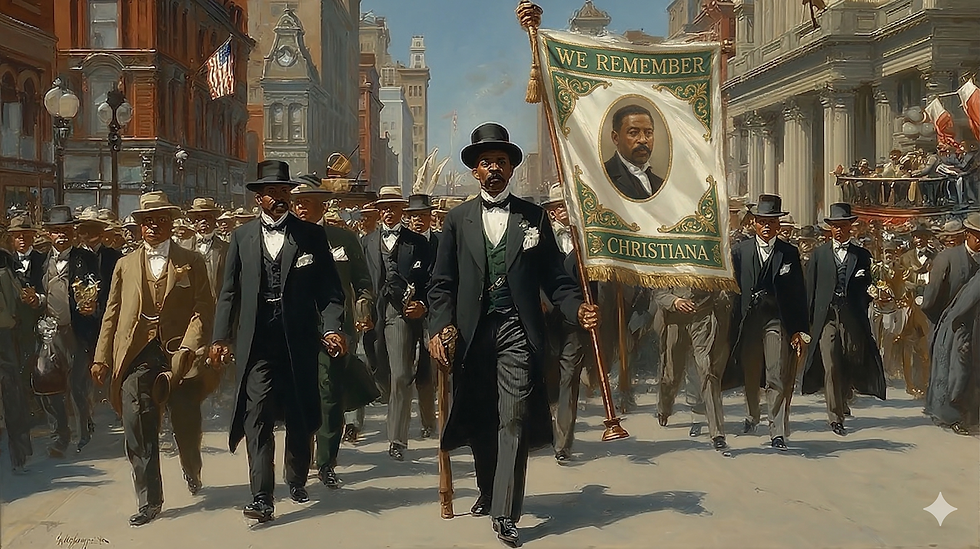
The 1882 article paints a picture of a genial final chapter - Williams passing time at a saloon at Seventh and Lombard "in a friendly game of cards or in reviving memories of the past."
He spent his last days at 604 Pine Street, where he died. That strip of Pine street is rich with Black history. Right next door - at 606 Pine - Dr. James J.G. Bias lived in the late 1850s. Dr. Bias died in that house in 1860.

The connection runs deeper. James Bias appears in William Parker's autobiographical narrative, The Freedman's Tale. One of the men charged with treason at Christiana was in jail awaiting trial when someone accused him of being a fugitive. They transferred him from Moyamensing Prison to Lancaster. His captors drank too much and fell asleep. George Williams saw his chance - escaped into a cold January night, walked fifteen miles in handcuffs until a friend removed them, then walked forty more miles to Philadelphia. When he arrived, he found Dr. Bias, who nursed him back to health.
And there are hints Bias had his own self-protection organization. William Carl Bolivar references the existence of "Bias' mob" in his Pencil Pusher column in the Philadelphia Tribune in 1913.
Our Very Own Uncle Sam
Let's bring our brave Uncle Sammy back to the icon status he held in 1871! As we approach the 250th anniversary of America, Black Philadelphia has a new Uncle Sam.
*There are earlier records but with a name like 'Samuel Williams' I can't be entirely sure it's him. For example, I'm pretty sure he attend early Colored Conventions as well. And that he was a member of the Benezet Joint Stock Association.
Sources
Webber, Amos. thermometer record and diary, Philadelphia, 1854-1866. Records of American Steel and Wire Company and its predecessors, Mss:596 1822-1936, Volume X.118; Reel 87-1350 R-1. Baker Library Special Collections and Archives, Harvard Business School. https://hollisarchives.lib.harvard.edu/catalog/bak01137_bak01137c00581
Aptowicz, Cristin O'Keefe. The Ballad of William Parker. Simon & Schuster, 2026.
"Boyer House Mob Attack." Public Ledger, 22 Aug. 1849. Newspapers.com, www.newspapers.com/article/public-ledger-boyer-house-mob-attack/194484837/.
"California House - Oct 10, 1849." Public Ledger, 10 Oct. 1849. Newspapers.com, www.newspapers.com/article/public-ledger-california-house-oct-10/194878641/.
"California House Court Case." Public Ledger, 22 Feb. 1850. Newspapers.com, www.newspapers.com/article/public-ledger-california-house-court-cas/194879439/.
"California House Legal Proceedings." Public Ledger, 5 Nov. 1849. Newspapers.com, www.newspapers.com/article/public-ledger-california-house-legal-pro/194877988/.
"California House Mob Attack Oct 11, 1849." Public Ledger, 11 Oct. 1849. Newspapers.com, www.newspapers.com/article/public-ledger-california-house-mob-attac/194879908/.
Carter Jackson, Kellie. Force and Freedom: Black Abolitionists and the Politics of Violence. U of Pennsylvania P, 2019.
Centennial Historical Souvenir of "Mother" Bethel A.M.E. Church, Philadelphia, Pa.: Also Places of Interest and Churches of All Denominations, (Colored). Introduction by R. R. Wright Jr., p. 35. HathiTrust, babel.hathitrust.org/cgi/pt?id=emu.010002643975&seq=38&view=2up.
Dorsey Collection. Samuel Williams file. Cheyney University.
"First Public Parade of the Liberty Guard." The Liberator, 27 Nov. 1857, p. 4.
Katz, Jonathan. Resistance at Christiana. 1974. Internet Archive, archive.org/details/resistanceatchri0000katz/page/326/mode/2up.
"Legalities of the White Mob Attack on the Black Community." Public Ledger, 21 Aug. 1849. Newspapers.com, www.newspapers.com/article/public-ledger-legalities-of-the-white-mo/194483709/.
"Lost Pocket Book to Return to Samuel Williams." Public Ledger, 14 July 1853. Newspapers.com, www.newspapers.com/article/public-ledger-lost-pocket-book-to-return/194483386/.
McElroy's Philadelphia City Directory. A. McElroy & Co., 1842.
"Owner of California House Is Charged for Defending His Own Place." Public Ledger, 22 Aug. 1849. Newspapers.com, www.newspapers.com/article/public-ledger-owner-of-california-house/194880199/.
Parker, William. "The Freedman's Story." Atlantic Monthly, vol. 17, part 1, Feb. 1866; part 2, Mar. 1866. Documenting the American South, docsouth.unc.edu/neh/parker1/parker.html.
"PENCIL PUSHER POINTS." Philadelphia Tribune, 21 Dec. 1912, p. 4. ProQuest.
Pennsylvania Abolition Society. Census, vol. 1, p. 25, 1847. Tri-College Digital Collections, digitalcollections.tricolib.brynmawr.edu/object/sc266996.
"Pennsylvania, Philadelphia, City Death Certificates, 1803-1915." Entry for Samuel M. Williams, 3 Sept. 1885. FamilySearch, www.familysearch.org/ark:/61903/1:1:JFSK-144.
"Samuel Williams (Christiana) Charged for Not Having a Liquor License." Public Ledger, 21 Aug. 1843. Newspapers.com, www.newspapers.com/article/public-ledger-samuel-williams-christian/194483874/.
"Samuel Williams (Christiana) Fined for Selling Liquor without a License." Public Ledger, 30 July 1846. Newspapers.com, www.newspapers.com/article/public-ledger-samuel-williams-christian/194877706/.
"Samuel Williams Charge." Public Ledger, 21 Sept. 1849. Newspapers.com, www.newspapers.com/article/public-ledger-samuel-williams-charge/194879993/.
"Samuel Williams with D. Colley in the 7th Ward - Prepares for Parade/Vote - Elected Marshal." The Evening Telegraph, 7 Apr. 1870. Newspapers.com,
"Stray Horses Recovered at 7th and Lombard by Samuel Williams of Christiana Fame." Public Ledger, 9 Dec. 1844. Newspapers.com, www.newspapers.com/article/public-ledger-stray-horses-recovered-at/194483988/.
"The Black Community Is Attacked." Public Ledger, 20 Aug. 1849. Newspapers.com, www.newspapers.com/article/public-ledger-the-black-community-is-att/194482626/.
"Uncle Sammy Williams' labors in the Interest of Fugitives" Newspapers.com, St. Louis Globe-Democrat, February 15, 1882, https://www.newspapers.com/article/st-louis-globe-democrat-uncle-sammy-wil/194884557/
Webber, Amos. thermometer record and diary, Philadelphia, 1854-1866. Records of American Steel and Wire Company and its predecessors, Mss:596 1822-1936, Volume X.118; Reel 87-1350 R-1. Baker Library Special Collections and Archives, Harvard Business School. https://hollisarchives.lib.harvard.edu/catalog/bak01137_bak01137c00581

